What Guangcai is
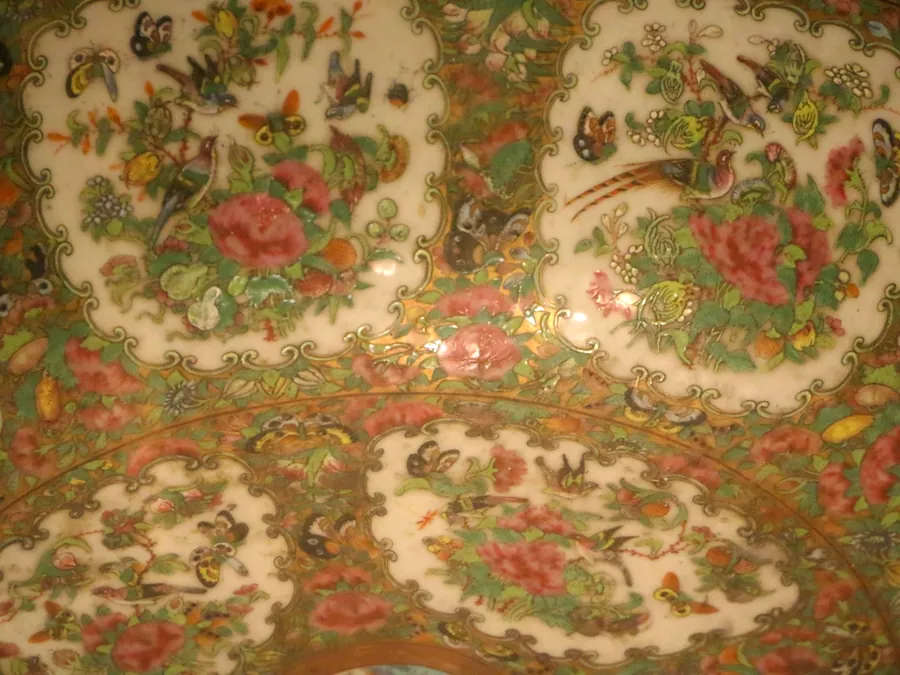
Guangcai — Canton gilded porcelain — is the one ceramic tradition China built specifically for export. From the Kangxi era onward, white porcelain blanks travelled down from Jingdezhen to Guangzhou, where local painters covered them in dense enamels and gold and refired them, before the finished pieces sailed from the Thirteen Factories wharves to the dining rooms of Europe.
The style the trade produced is unmistakable: crowded compositions of peonies, birds and courtly scenes, framed in gold. The gold is the signature — Guangzhou’s painters gild more heavily than any other Chinese school, which is why the ware is also called “gold-woven coloured porcelain”.
The workshop, and what you actually do
The studios we use sit in Yongqing Fang, the restored heritage quarter in Liwan where the city’s intangible-heritage workshops are gathered — a street of Qing-era lane houses a few minutes’ walk from the Chen Clan Ancestral Hall. They are working studios run by accredited inheritors of the craft, not tourist classrooms.
A class runs about ninety minutes. The inheritor opens with the history and the marks that distinguish good Guangcai, demonstrates the full sequence — drafting, outlining in black mineral pigment, filling colour, then tracing gold — and then puts a brush in your hand on a blank plate or cup. You keep your piece: the studio fires it after you leave and delivers it to your hotel or ships it home.
Firing, and why your colours will change
Guangcai pigments are mineral-and-glass compounds whose colours transform in the kiln — the dull greys and muted reds you paint with emerge as brilliant rose, emerald and gold after firing. The inheritors teach you to judge the fired result from the unfired one, which is the real skill of the trade.
Firing typically takes a few days to two weeks depending on the studio’s schedule. If you are still in Guangzhou, the finished piece comes to your hotel; otherwise it ships — this is, after all, the trade that invented shipping porcelain home.
Making a day of it
The workshop anchors naturally into a Liwan day: the Chen Clan Ancestral Hall — the finest Lingnan decorative architecture in the city, open 09:00–17:30 — is a few minutes away, Yongqing Fang’s lanes and tea houses fill the rest of the block, and Shamian Island’s colonial riverfront is a short walk south. We sequence the day around your class time and finish with dinner in the same district.
What is included
- A 90-minute class in a working Guangcai studio, taught by an accredited inheritor
- One blank plate or cup per person, all pigments and gold included
- Kiln firing after the class, with hotel delivery or international shipping
- An English briefing pack on Guangcai history and how to read the marks
Prices are per person and confirmed at booking. Experiences can be added to any route or booked standalone.
Questions travellers ask
Can tourists join a Guangcai painting workshop without speaking Chinese?
Yes. The inheritors we book are used to international visitors, we brief you beforehand, and a bilingual member of our team can accompany the class on request. Painting needs no shared language — the brush does the talking.
How long until my painted porcelain is fired and ready?
Typically a few days to two weeks depending on the studio’s kiln schedule. If you are still in China we deliver it to your hotel; if you have flown home we ship it internationally — the original export trade, rerouted to you.
Is the workshop suitable for children?
Children from about six years old do well — the outlining step rewards patience more than talent. For families we schedule a shorter session with simpler patterns and pair it with the Chen Clan Ancestral Hall on the same morning.
Where does the workshop take place?
In the intangible-heritage studios of Yongqing Fang, in Liwan — the same district where Guangzhou’s porcelain trade was centred when it supplied Europe. Studio locations are confirmed when we book your slot.
Routes that include Guangzhou
October to April · Moderate · Easy
The most efficient first trip into China from Hong Kong or Southeast Asia. Two mainland cities with genuinely different characters, one hour apart on the high-speed rail, finished with a half-day in Macau across the border.
From US$1,400per person
View the route
More experiences
Food ritual · Guangzhou
2–3 hours · from US$25
Not breakfast and not brunch: a two-hour sit-down ritual of tea and dim sum that Guangzhou runs every morning of the year. We…