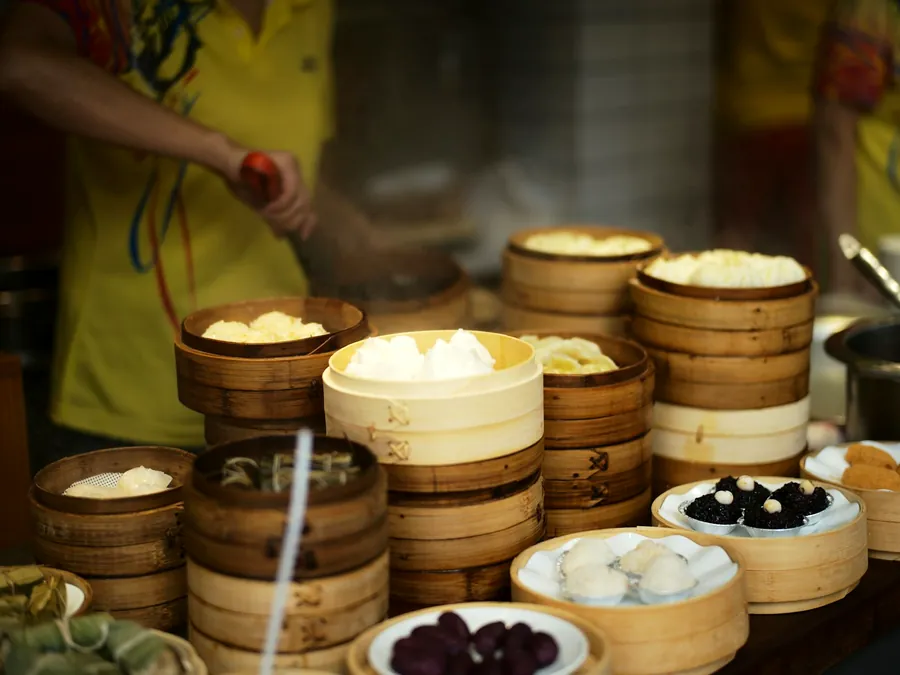
What morning tea actually is
Yum cha — “drink tea” — is the Cantonese answer to the question of how a city eats breakfast when nobody is in a hurry. From around seven in the morning, the great dim sum houses of Guangzhou fill with families, retirees with newspapers, and friends holding tables until noon. Tea is the constant; the food arrives in small steamer baskets, one round at a time, for as long as you care to stay.
The classic phrase for it is “one pot, two pieces” — a pot of tea and two items of dim sum. In practice a table of four will work through eight to twelve baskets over a couple of hours, which is why the bill, for all its abundance, usually lands around ¥60–120 per person.
How it works when you sit down
You are shown to a table, asked which tea you want — Pu’er for the bold, chrysanthemum for the mild, Tieguanyin or jasmine in between — and almost immediately handed a bowl, a cup and a kettle of hot water. Rinsing your own bowl and cup at the table is not a comment on the washing-up; it is the opening move of the ritual, and doing it without self-consciousness is the first mark of a regular.
Ordering is done on a paper sheet you tick yourself, or from trolleys that circle the room. Either way the rule is the same: order a few, eat, order more. Nothing arrives all at once, and nothing is expected to.
The dishes to order first
Har gow (crystal shrimp dumplings) is the benchmark — a kitchen is judged on it. Siu mai pork-and-shrimp dumplings, barbecue-pork buns, rice-noodle rolls (cheung fun) with sweet soy, pan-fried turnip cake, chicken feet in black-bean sauce, congee with century egg and pork, and egg tarts to close. One or two pieces per person per round, shared, is the local rhythm.
Dim sum literally means “touch the heart” — the portions are small by design. If you order a plate of everything at once you will have done it wrong, and you will be full before the interesting things arrive.
The etiquette, in one minute
When someone pours tea for you, tap two bent fingers on the table — the silent thank-you that legend traces to a Qianlong-era emperor travelling incognito. Pour for others before yourself, and never let a teapot spout point at a fellow guest. When the pot runs dry, leave the lid resting open on the rim or ask for more water; both are understood.
None of this is policed. But doing it earns a small, real nod from the regulars at the next table — which is, in the end, what the experience is for.
Where to do it
The century-old houses are the point: Tao Tao Ju (since 1880) and the Guangzhou Restaurant (since 1935) for the full-flagship experience, and Panxi in Liwan — a 1947 house built around lakeside garden pavilions — for the most atmospheric room in the city. Dian Dou De, a newer chain with an all-day service, is the reliable answer when a mid-morning arrival makes the old houses impractical.
Several of the city’s Michelin-listed Cantonese kitchens also run a daytime dim sum service in more formal surroundings. We book the house to match the day: garden pavilions and trolley ladies for atmosphere, hotel dining rooms for comfort after a long flight.
What is included
- Table reservation at a house matched to your day (garden room or hotel salon)
- First round of tea and dim sum ordered on your behalf, with the menu explained
- A one-page etiquette and ordering card in English
- A planner on WhatsApp for the morning, in case you want to extend the table
Prices are per person and confirmed at booking. Experiences can be added to any route or booked standalone.
Questions travellers ask
What is Cantonese morning tea?
Yum cha — a sit-down ritual of tea and dim sum, eaten slowly over two or three hours, most often in the morning. It is the defining meal of Guangzhou, and unlike anything on a hotel breakfast buffet.
What time should I go for morning tea in Guangzhou?
The classic session runs 07:30–10:30 on a weekday, when the old houses are at their most local. Sundays are the busiest morning of the week; arrive before 08:00 or after 13:00 to skip the queue.
How much does morning tea cost?
Roughly ¥60–120 per person — about US$10–17 — for tea and a generous table’s worth of dim sum. It is one of the great-value meals in China.
Do I need to speak Chinese or book in advance?
No and not usually — top houses fill on weekends, so a reservation helps. We book the table and order the first round for you; after that the tick-sheet and trolleys are self-explanatory.
I don’t drink tea. Can I still do morning tea?
Yes. Every house serves soy milk and plain hot water, and nobody minds. But try the chrysanthemum at least once — morning tea without tea is a bit like a concert without the orchestra.
Routes that include Guangzhou
October to April · Moderate · Easy
The most efficient first trip into China from Hong Kong or Southeast Asia. Two mainland cities with genuinely different characters, one hour apart on the high-speed rail, finished with a half-day in Macau across the border.
From US$1,400per person
View the route
More experiences
Craft workshop · Guangzhou
90 minutes, plus firing · from US$35
Paint your own piece of Guangcai — the gilded export porcelain Guangzhou has made for Europe for three hundred years — under a…